Many see mentorship as a linear process, with a strict beginning and end. However, the Alberta Immigrant Mentorship Network’s (AIMN) session on October 2nd, 2025, inspired participants to think differently.
Moderated by Cheryl Whitelaw of AIMN and Doug Piquette from the Edmonton Region Immigrant Employment Council (ERIEC), the online session explored formal and informal methods of mentorship and strategies on how to integrate mentorship into programs and events rather than approaching it as a standalone, linear process.
In the session, attendees heard from a panel of community leaders who have woven mentorship opportunities into their unique initiatives. Guest speakers included:
- Salome Asea, Director of Programs and Accountability at Africa Centre
- Christine Parent, Manager of People & Post-Secondary Engagement at Chartered Professionals in Human Resources (CPHR) Alberta
- Juan Arias, Alberta Global Talent Coordinator at Central Alberta Refugee Effort Central Alberta Refugee Effort (CARE)
The following key points emerged as the conversation progressed:
- Mentorship is multidimensional: Mentorship can thrive in formal and informal settings, depending on the needs of the moment. Embracing this flexibility and recognizing when an informal or formal setting is needed is essential for building meaningful and effective mentorship relationships.
- Mentorship is inherently versatile: Mentorship adapts to challenges, navigates setbacks, works within limited resources, and responds to the unexpected realities that arise along the way.
- Mentorship creates learning opportunities for everyone involved: Mentors and mentees grow together as they problem-solve, build trust, share resources, and gain insights into each other’s experiences and challenges.
Salome Asea from Africa Centre spoke on the ways mentorship is integrated into the Centre’s events and programs. Africa Centre, the largest pan-African non-profit organization in Western Canada, offers high-quality and culturally-informed programming and access to services to support the diverse families they work with. Their mentorship focuses on leveraging individuals' talent and skills and establishing ways to bring these skills to the wider community.
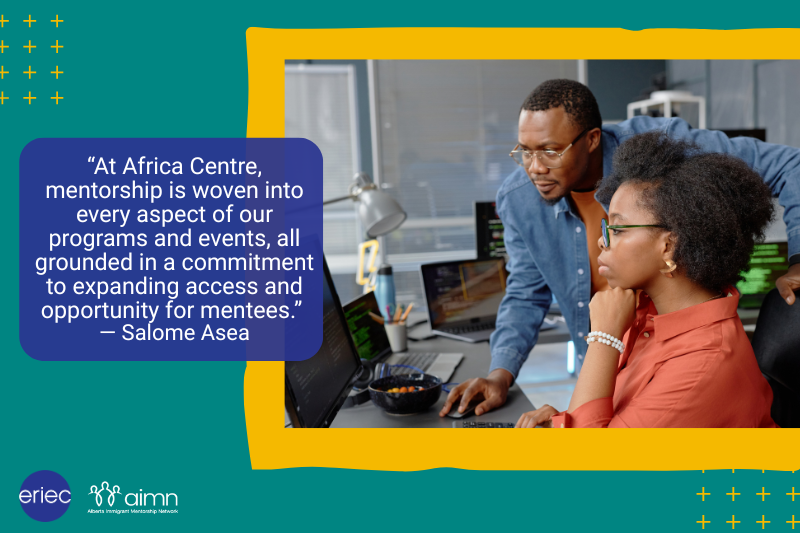
“At Africa Centre, mentorship is woven into every aspect of our programs and events, all grounded in a commitment to expanding access and opportunity for mentees,” Salome says. The Centre aims to create pathways for newcomers—especially those without existing networks—to build relationships, connect with the community, and showcase their talents.
Formal mentorship at Africa Centre is seen through their Fellowship Program, which offers leadership training, board governance education, and capacity-building opportunities, and places young people in spaces they might not typically access. Informal mentorship is ingrained in Africa Centre’s daily culture, showing up in tutoring, basketball, community courses, volunteer roles, annual general meetings, galas, and every space where youth can engage meaningfully.
Christine Parent, from CPHR Alberta, “the professional association dedicated to strengthening the Human Resources profession and upholding the highest standards of practice,”[1] shares that CPHR also approaches mentorship in formal and informal ways. With a membership of 7,300 Human Resources (HR) professionals, made up of both students and workers, CPHR’s mentorship revolves around trying to engage students and give them as many opportunities to connect within the HR community as possible.
Chartered Professionals in Human Resources’ formal mentorship strategies are built into their programming. The Walk and Talk Program connects students to HR professionals for two-hour virtual or in-person conversations, and the Work Integrated Learning (WIL) Program gives mentees the chance to make real HR decisions within the company over the course of two years, review those choices with mentor support, and see the real-time impact of their decisions.
Christine shares that mentoring can mean guiding people through challenges while letting them lead, helping them build confidence in handling situations independently. Strong mentors stay open to different approaches, giving mentees ownership in their success. Informal mentorship at CPHR is seen in moments where staff help walk mentees through challenges by asking, “What would you do?”, an approach that encourages mentees to develop their own solutions and build their confidence. “It is always a two-way learning process,” Christine says, “with both mentors and mentees gaining insight as they navigate challenges together.”
With a focus on empowerment, CPHR has seen mentees become more motivated, confident, and driven in their participation at networking events, with an increase in their willingness to step up and engage.
Juan Arias from Central Alberta Refugee Effort (CARE) in Red Deer emphasizes that opportunities for mentorship can arise from any and every interaction. Central Alberta Refugee Effort focuses on “helping newcomers settle into Central Alberta with resources, education, and support as they arrive in Canada.”[2] Their mentors must shift their mindsets from mentorship as following one pre-set trajectory to acting as bridges to help newcomers find what they need based on their individual circumstances. This approach strengthens community connections for mentees and ensures they receive support that extends far beyond a one-time event.
“Mentors support newcomers during some of their lowest and most uncertain moments, especially as they rebuild after leaving so much behind,” Juan says. Whether formally or informally, CARE’s mentors play a vital role in fostering a welcoming space for newcomers, helping boost confidence and encouraging both personal and professional growth by creating a supportive community that stands with them throughout their journey.
“Mentorship can turn into a lifetime friendship,” Juan says. The mentor-mentee relationships also open a space to learn from one another and celebrate cultural exchange, making mentee progress especially rewarding to witness.
Central Alberta Refugee Effort implements formal mentorship through their Companionship Program, where newcomers are paired with Canadians and resident volunteers to learn about life in Canada and feel more comfortable in their new community. Informally, Juan shares that mentorship can be as simple as “a walk in the park” or “talking to a friend,” and enjoying the non-verbal conversations that come with getting to know people beyond the formal environment.
Integrating mentorship into events and programming does come with its challenges, and our panellists emphasized that every mentorship journey is unique. Some of the common hurdles to integrating mentorship into events and programming include:
- Helping mentees learn to see and present themselves as assets to organizations and communities while balancing honesty and confidence. This can be challenging across diverse backgrounds.
- Maintaining commitment, especially for newcomers navigating settlement-related challenges. Sustained engagement requires mentors to listen actively, stay open to different approaches, and ask thoughtful questions that guide mentees towards solutions.
- Recognizing that mentees need varying levels of support, which makes setting clear expectations and timely interventions crucial. Even small tasks can become unexpected barriers, and mentors must remember that everyone navigates the world differently and must listen closely to offer the right support.
Mentorship has long been a powerful connector, one that builds confidence, offers guidance, and creates opportunities that move through communities. Its versatility makes it possible for mentorship to be woven into community programs and events, both formally and informally.
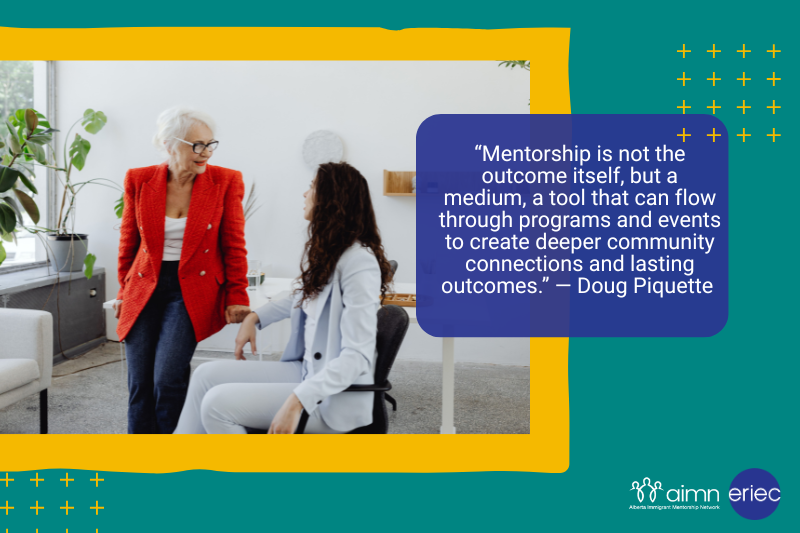
As Doug says, “[Mentorship] is not the outcome itself, but a medium, a tool that can flow through programs and events to create deeper community connections and lasting outcomes.” Being a mentor means helping weave mentorship into the fabric of community life and serving as a catalyst for impact that extends far beyond individual mentor-mentee relationships.
The AIMN is sponsored by ERIEC. The AIMN is appreciative of the funding from the Edmonton Community Foundation. Our program is here to provide information and support to help organizations start mentorship programs.
References:
[1] HR professional association: CPHR Alberta. About CPHR Alberta. (2024). https://www.cphrab.ca/about-cphr
[2] CARE for Newcomers. Welcome to Canada! (20220. https://www.carefornewcomers.ca/