On December 10th, 2025, the Alberta Immigrant Mentorship Network (AIMN) met for a discussion and reflection on the future of mentoring in Alberta, and to share insights from the recent Mentoring Summit in November by Mentor Canada. In attendance were mentor program professionals and community leaders interested in mentorship.
Doug Piquette and Cheryl Whitelaw initiated the discussion in this community of practice, drawing from their findings at the Mentoring Summit.
The session highlighted the following trends in mentorship in Alberta:
Mentee Retention
Mentees are not seeing mentorship programs through and have become less engaged and committed. Many are seeking immediate employment and feel they do not have time to wait for the program to conclude. This shift has had a direct impact on the overall success and outcomes of mentorship programs. Previously, retention challenges were more common among mentors, whereas now the issue has shifted to mentees. Mentors, meanwhile, expressed fatigue from repeatedly sharing their experiences and networks, especially when mentees do not fully engage or take the learning process seriously. There is impatience and frustration on both sides of the equation; mentees aren’t seeing results right away, and mentors are frustrated with non-committal attitudes.
Key Takeaway: This highlights the importance of considering the demographics and economic realities of the populations that mentorship programs serve, as their priorities and constraints may differ significantly from past cohorts.
Varying Levels of Consistency Depending on Demographics
During the discussion, panellists noted that mentees from post-secondary institutions tend to be more consistent in their participation in mentorship programs. At the same time, there remains a sense of entitlement among some participants who expect immediate employment, underscoring the need to set realistic expectations, particularly around so-called “fast-track” job pathways.
Key Takeaway: Mentorship programs can be tailored to cater to specific demographics and strategic timelines around program launches play a significant role in mentee recruitment and retention.
Need for Support in Future-Proofing Careers since AI
The conversation also touched on broader workforce shifts, including women navigating leadership pathways and grappling with the impact of AI on their roles, prompting important questions about how to future-proof careers in a rapidly changing landscape.
Key Takeaway: Mentees require support in adapting to and future-proofing their careers during the emergence of AI and workforce shifts.
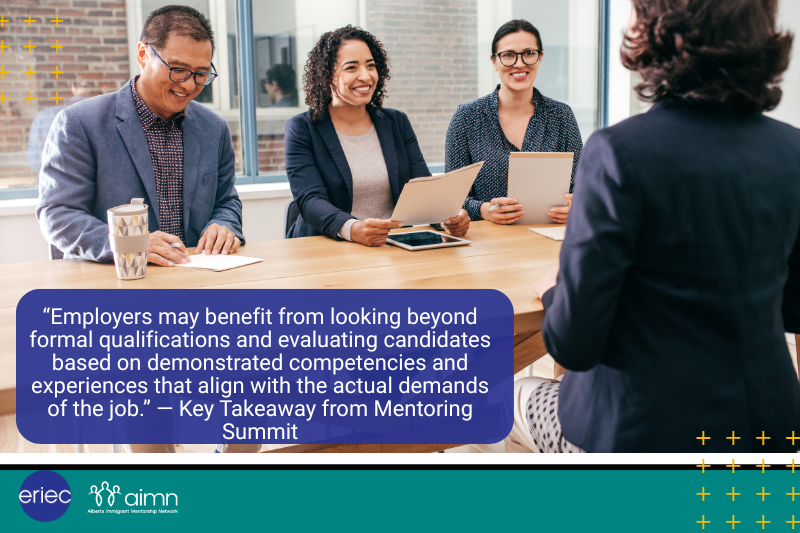
Post-Secondary Education Does Not Guarantee Problem-Solving Skills
Many workplaces assume that hiring university graduates is the best option, but this isn’t always the case. Employers often expect new graduates to be job-ready; yet many lack critical thinking, creativity, and practical problem-solving skills. These gaps are partly driven by funding cuts that eliminate courses focused on workforce preparation. Not all students have the opportunity to learn critical thinking in a real-world environment. Additionally, while mentorship remains a proven and valuable tool, the discussion raised an important question about whether organizations and institutions are investing in scalable models that can expand their reach and long-term impact.
Key Takeaway: Life experience, such as working and resolving real-world issues, play a major role in developing the critical thinking skills that are vital in the workplace. Hiring a university graduate does not automatically guarantee that they possess the problem-solving skills required for a role, just as an international candidate without Canadian university experience should not be assumed to lack these abilities. Skills such as analytical thinking, adaptability, and effective problem-solving are often developed through a combination of education, work experience, and facing real-world challenges rather than credentials alone. Employers may benefit from looking beyond formal qualifications and evaluating candidates based on demonstrated competencies and experiences that align with the actual demands of the job.
Cheryl also highlighted a US-based study involving young adults from minority groups who participated in a program designed to support successful transitions into the workplace. The program emphasized the following:
- Core mentoring: To build strong trust between mentors and mentees.
- Capacity mentoring: To help participants navigate professional environments and cross-cultural dynamics.
At its core, the initiative focused on developing individuals’ capacity to confidently and effectively move into the workplace, underscoring the role of intentional mentorship in long-term career success.
In closing, Doug summarized the sessions by speaking on the need to adapt mentorship to emerging realities, particularly as AI becomes an unavoidable part of education and the workplace.
“Rather than resisting these changes in mentorship trends, it is important to actively engage in ongoing conversations about mentorship, recognizing that it continues to evolve rapidly,” he said.
Attendees were encouraged to take shared insights, apply them thoughtfully, and approach mentorship creatively. Staying informed, participating in discussions, and exchanging ideas are key to keeping mentorship visible and relevant.
Read more:
- Highlights from the Mentor Canada Summit in Calgary in November. With a little AI support, this document summarizes insights, inspirations, and resources gleaned from the conference.
- Highlights from the recent Foreign Qualifications Advisory Committee Report (2025). This document summarizes recommendations and insights from the report relative to the future of mentoring.
The AIMN is sponsored by ERIEC. The AIMN is appreciative of the funding from the Edmonton Community Foundation. Our program is here to provide information and support to help organizations start mentorship programs.